● Case study
Althea
AI-Powered Emotional Self-Coaching Platform
• Node.js • JavaScript • AI/LLM Integration • Prompt Architecture • Typescript • Ionic-React • SQL • Firebase
MY ROLE
Full-Stack & AI Product Developer
PROJECT TYPE
AI Product Development
STATUS
Ongoing project
Overview
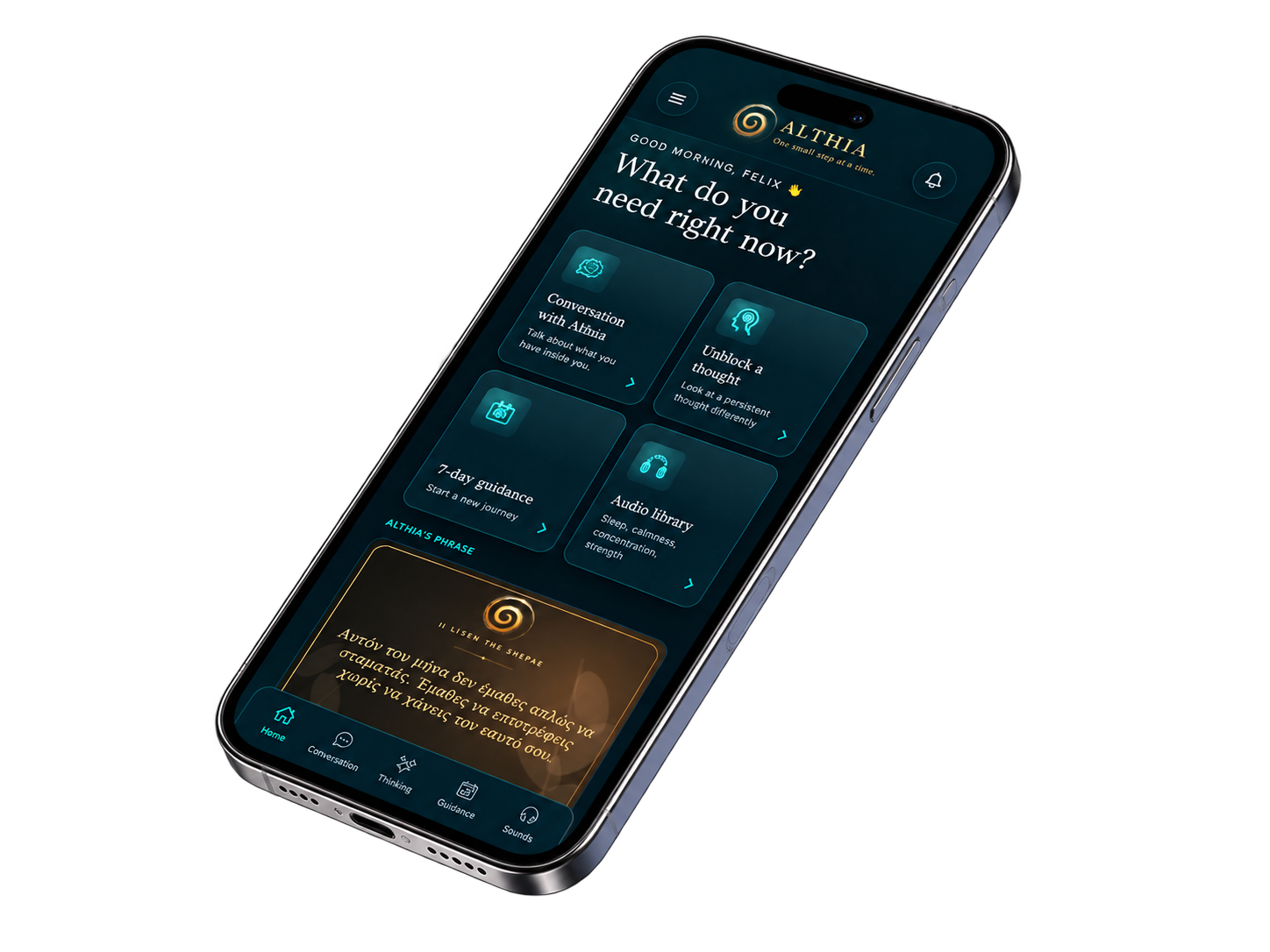
Althea is a bilingual AI-powered emotional self-coaching platform built to deliver focused, context-sensitive conversations in English and Greek.
Unlike a general-purpose chatbot, Althea is designed around a specific product experience. The system uses application-level routing, language rules, response constraints, and evaluation logic to keep conversations aligned with its intended role.
My work focused on the product’s AI behaviour architecture, backend logic, conversation routing, multilingual handling, and the controls that govern how the underlying language model behaves inside the application.
The challenge
Connecting an application to an AI model is relatively simple. Making that AI behave consistently as a specialized product is much harder.
Althea needed to:
- recognize different types of emotional conversations;
- respond appropriately to short or low-information messages;
- support English, Greek, and Greeklish consistently;
- maintain strict product boundaries instead of becoming a general assistant;
- apply different conversational strategies based on context;
- keep AI instructions maintainable as the product evolved;
- evaluate important response requirements without adding unnecessary AI calls.
The challenge was therefore not just AI integration—it was creating enough structure around the model to produce a predictable, intentional product experience.
The solution
I built an application-level behaviour architecture around the AI instead of relying on one universal prompt.
Incoming conversations are routed through specialized behaviours based on the type of interaction taking place. This allows different emotional situations to use different instructions, boundaries, and response strategies.
Language handling is also controlled at the application level: English input receives English responses, Greek input receives Greek responses, and Greeklish is returned in Greek script.
Prompts are separated into structured resources so individual behaviours can be refined without rewriting the entire AI system. A rule-based evaluation layer also checks important response requirements without requiring another language-model request for every interaction.
The result is a system where the underlying AI remains flexible, while Althea controls how that intelligence is expressed inside the product.
● Key features
Context-Aware Conversation Routing
Different conversational situations are routed through specialized behaviours rather than one generic assistant flow.
Multilingual Conversation Experience
Supports English and Greek conversations, including Greeklish input returned naturally in Greek script.
Product-Specific AI Boundaries
Application-level rules prevent the assistant from drifting outside Althea’s intended emotional self-coaching experience.
Low-Information Message Handling
Short emotional messages receive focused acknowledgement and appropriate conversational narrowing instead of unnecessarily long responses.
Structured Prompt Architecture
AI instructions are separated by purpose and behaviour, making the system easier to maintain, test, and improve.
Rule-Based Response Evaluation
Important behavioural requirements can be checked locally without introducing another AI-model call into every interaction.
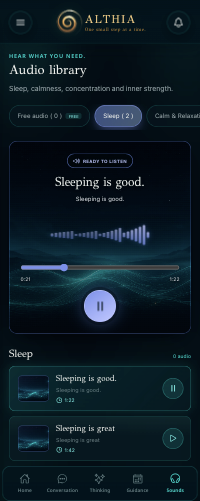
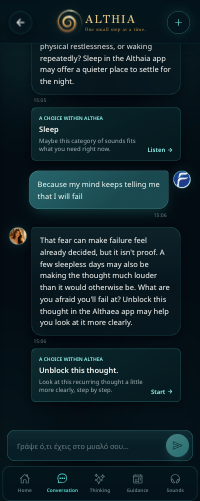
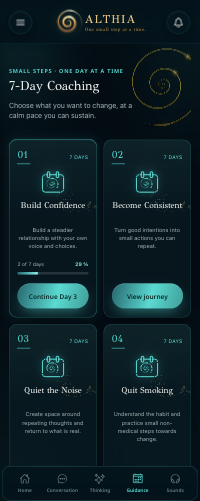
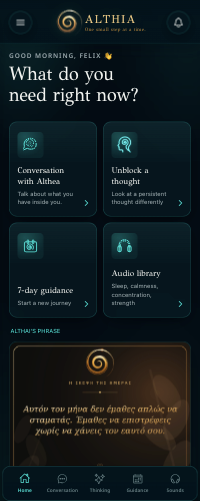
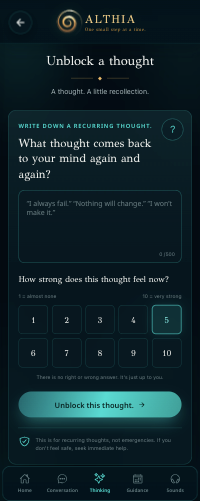
My contribution: AI behaviour architecture, backend logic, multilingual conversation handling, context-aware routing, structured prompt design, rule-based response evaluation, and product-specific AI controls.
Have a product idea that needs more than basic development?
I help founders and businesses turn complex product requirements into reliable, production-ready software.